
RECURSOS · 25 agosto, 2026
Pastoral Counseling as a Profession of Wisdom
Pastoral Counseling as a Profession of Wisdom, Community, and Human Development
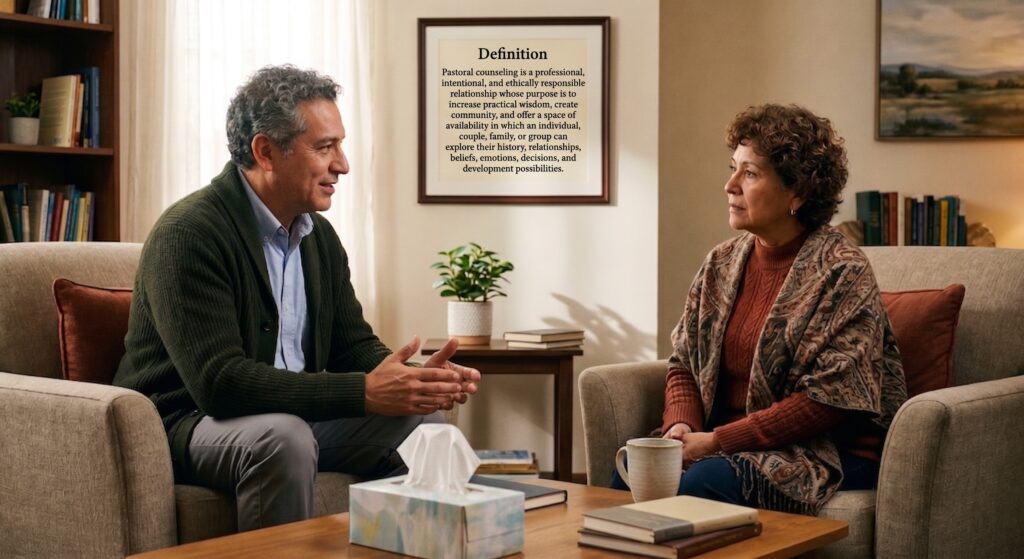
Definition
Pastoral counseling is a professional, intentional, and ethically responsible relationship whose purpose is to increase practical wisdom, create community, and provide a supportive space in which an individual, couple, family, or group can explore their history, relationships, beliefs, emotions, decisions, and possibilities for growth.
Functions of Pastoral Counseling
In this relationship, the strengths that give life are recognized, and the obstacles that restrict human development are identified. Efforts are made to understand and address the distortions of the soul. Pastoral counseling also assists people in their spiritual growth and in the development of faith—understood as trust in themselves, in their allies, and in the Creator.
Increasing wisdom does not mean accumulating information or receiving ready-made answers from a religious authority. Practical wisdom allows one to understand a situation within its context, recognize its ethical implications, consider foreseeable consequences, and make decisions that protect dignity and promote life. The pastoral counselor does not make decisions for those seeking assistance. Instead, they offer questions, knowledge, perspectives, and resources that expand the client’s capacity for discernment. The goal is not to engender obedience or dependence, but to strengthen responsible self-determination that can be exercised in relation to other people, the community, and the responsibilities that each decision entails.
Pastoral counseling also seeks to build community. Suffering can intensify when a person feels isolated, misunderstood, or cut off from their trusted sources of support. Building community means fostering relationships in which a person can be acknowledged, heard, and treated as a valued participant. It is not limited to welcoming someone into a congregation. It may include rebuilding connections with family members, friends, faith communities, support networks, and allies, as well as discerning which relationships are no longer life-giving. There is strong evidence supporting the importance of social relationships for human health. Julianne Holt-Lunstad, Timothy B. Smith, and J. Bradley Layton (2010) conducted a meta-analysis of 148 studies involving 308,849 participants. They found that stronger social relationships were collectively associated with a higher probability of survival.
The space of availability constitutes a distinctive contribution of pastoral counseling. Being available involves offering time, presence, attention, and a relationship trustworthy enough for another person to speak without being reduced to a diagnosis, a moral problem, or a religious category. In that space, they can express doubts, fears, relationship breakdowns, conflicts, experiences with God, and questions they may not find elsewhere to ask. Pastoral availability is not passivity. It involves listening attentively, discerning, asking questions, offering perspective, confronting when necessary, and protecting the person’s freedom. It also requires recognizing the limits of one’s own competence and referring the person to other services when the situation calls for it.
Through this professional relationship, the pastoral counselor fosters spiritual development. Spirituality is understood as the human capacity to transcend immediate experience to find meaning, purpose, and connection with that which gives life to existence. This process involves an inward movement that allows for renewal through self-care, the integration of one’s personal history, the construction of meaning, the development of purpose, and the cultivation of faith. It also involves an outward movement expressed through revitalization, responsible relationships, service, justice, the defense of human dignity, care for creation, and contributions to the common good.
Research from related fields provides relevant evidence for this understanding, though it should not be conflated with direct evidence of the effectiveness of pastoral counseling as a specific discipline. The meta-analysis by Laura E. Captari and her colleagues (2018), focused on psychotherapy, included 97 outcome studies with 7,181 participants and found that interventions adapted to religious or spiritual beliefs and values could promote psychological and spiritual functioning in certain comparisons.
In the methodologically most rigorous studies that added religious or spiritual adaptation to established treatments, no significant advantage was observed in reducing psychological distress, but greater spiritual well-being was observed. Meanwhile, the systematic review by Robert W. Kirchoff and colleagues (2021), conducted in hospital settings, found that receiving spiritual care was correlated with greater satisfaction among patients and family members, and that chaplaincy interventions were associated with improvements in perceived quality of life and spiritual well-being. These studies alone do not prove the effectiveness of any form of pastoral counseling. They do, however, support the importance of addressing the spiritual dimension competently and in a manner consistent with the values and preferences of the person receiving care.
Pastoral counseling also assists in the development of faith. Faith is not merely about accepting doctrines. It is a form of trust that develops, is questioned, is strengthened, and, at times, needs to be rebuilt. A life-giving faith can hold onto convictions without denying uncertainty, engage with those who think differently without dehumanizing them, and live with mystery without resorting to explanations that unnecessarily increase fear or guilt.
In a longitudinal study of 268 medically ill, hospitalized elderly patients, Kenneth I. Pargament, Harold G. Koenig, Nalini Tarakeshwar, and June Hahn (2004) found that different forms of religious coping were associated with different outcomes. Positive forms were associated with improvements in various indicators, while some negative forms predicted subsequent deterioration. The scope of this study is limited to a specific clinical population, but it illustrates an important pastoral issue. It is not enough to ask whether a person has faith; it is necessary to understand how that faith shapes the way they interpret suffering, relate to others, and make decisions.
Within this framework, the pastoral counselor helps identify and address distortions of the soul. This expression does not propose a medical, psychiatric, or psychological category, nor does it understand the soul as an entity separate from the human organism. The soul is used as pastoral language to refer to lived interiority, in which memory, emotions, desires, beliefs, moral conscience, imagination, meaning, and transcendence are intertwined within an indivisible biological, historical, cultural, and social existence. Distortions of the soul are, therefore, ways of interpreting, feeling, relating, or acting that restrict one’s ability to perceive with sufficient clarity, to assume responsibility, and to participate in what promotes life.
These distortions can manifest at the individual level through destructive shame, ego inflation, inner emptiness, or rigid thought patterns. They can take on a social dimension when racism, inequality, prejudice, violence, or the abuse of power are presented as natural, inevitable, or morally justifiable. They can also be epistemic. Miranda Fricker (2007) showed that a person can be harmed precisely in their capacity as a subject of knowledge when prejudice unjustly diminishes the credibility attributed to their testimony or when they lack shared interpretive resources to make a relevant experience intelligible. Ian James Kidd and Havi Carel (2017) explored this issue in the context of illness and healthcare, demonstrating how stereotypes and power structures can lead to testimonial and hermeneutic injustice. In the spiritual realm, distortions can manifest as punitive images of God, imposed guilt, paralyzing religious fear, indiscriminate demonic attributions, false promises, or dependence on religious leaders that undermine self-determination.
Pastoral counseling also assists with the formation, strengthening, and breakdown of relationships. It can help develop the ability to communicate needs, set boundaries, acknowledge others, and manage conflicts. Repairing a breakdown, however, does not mean preserving every relationship. Some relationships can be strengthened through truth, accountability, restitution, and verifiable changes. Others need to be limited or ended to protect safety and dignity. The pastoral counselor must carefully discern between reconciliation and a return to destructive conditions. Forgiveness, when it is part of the client’s convictions, does not require denying the harm or automatically restoring trust.
In this understanding of the profession, the defense of human rights is part of pastoral responsibility. Assistance that listens to suffering but remains indifferent to the conditions that cause it risks spiritualizing injustice. Advocacy can mean helping a person understand their rights, access services, participate in decision-making, protect their confidentiality, obtain language assistance, or respond to abuse. The World Health Organization (2023) notes that the right to health is indivisible from other rights related to education, participation, housing, work, and information, and that non-discrimination is a fundamental principle. The pastoral counselor does not replace the voice of the person receiving assistance. Rather, they use their position and resources to help ensure that their voices are heard and exercised with greater freedom.
These functions converge to promote integral human development. The human organism constitutes an indivisible unit that thinks, imagines, feels, remembers, interprets, relates, acts, and transcends under the combined influence of biology, culture, history, and context. Therefore, pastoral counseling does not fragment the spiritual experience of biological existence, does not separate the person from their relationships, nor does it reduce individual suffering to an exclusively intrapsychic explanation. It examines life in its multifaceted relationships and recognizes when a need falls within its scope of practice and when it requires coordination with other professions or access to other services.
Pastoral counseling has its own professional identity, while maintaining a constant dialogue with psychology, professional counseling, psychiatry, social work, education, and other human sciences. It may utilize intervention models developed in these fields without thereby becoming a variant of any of them. This interdisciplinary approach requires a critical understanding of the assumptions, scope, and limits of the models employed, using them within the practitioner’s area of competence and relating them to pastoral theology, spirituality, culture, ethics, human rights, and the wisdom of communities. The distinctive contribution of pastoral counseling does not lie in claiming jurisdiction over all dimensions of human life, but rather in offering a professional form of assistance in which spiritual, relational, ethical, and faith-based questions can be examined without being automatically subordinated to categories specific to another discipline.
As a professional discipline, pastoral counseling requires specialized education, defined competencies, supervision, continuing education, membership in and accountability to professional communities, and ethical guidelines that regulate the use of authority and power. Some organizations have formalized this identity through standards and certification processes. The College of Pastoral Supervision and Psychotherapy (CPSP, 2022), for example, expressly includes certification as a Clinical Chaplain/Pastoral Counselor and distinguishes this competency from state-regulated mental health practice; furthermore, it maintains a specific code of professional ethics (CPSP, 2020). This professional reality should not be confused with legal uniformity. Protected titles, licenses, and the legal scope of practice vary across jurisdictions, and pastoral certification alone does not authorize the practice of a regulated mental health profession. Precisely for this reason, a solid professional identity requires an understanding of the limits of one’s competence, applicable legal obligations, and the criteria for consultation, coordination, or referral.
Understood in this way, pastoral counseling can be described as a profession dedicated to its own revitalization to revitalize others. Those who practice it offer a professional relationship in which people can increase their wisdom, build or rebuild community, recognize strengths, confront obstacles to growth, examine distortions of the soul, grow spiritually, and develop their faith. Their authority does not stem simply from ordination, doctrinal knowledge, or institutional position, but from verifiable training, ethically responsible practice, and a willingness to subject their own judgment to supervision and accountability. The goal is not to control what another person should believe or decide, but to expand their capacity to discern, relate to others, exercise their rights, and participate responsibly in building a more dignified and life-giving life.
References
Captari, L. E., Hook, J. N., Hoyt, W., Davis, D. E., McElroy-Heltzel, S. E., & Worthington, E. L., Jr. (2018). Integrating clients’ religion and spirituality within psychotherapy: A comprehensive meta-analysis. Journal of Clinical Psychology, 74(11), 1938–1951. DOI 10.1002/jclp.22681.
College of Pastoral Supervision and Psychotherapy. (2020). CPSP Code of Professional Ethics and Principles for Processing Ethical Complaints.
College of Pastoral Supervision and Psychotherapy. (2022). Certification Manual.
Fricker, M. (2007). Epistemic Injustice: Power and the Ethics of Knowing. Oxford University Press. DOI 10.1093/acprof:oso/9780198237907.001.0001.
Holt-Lunstad, J., Smith, T. B., & Layton, J. B. (2010). Social relationships and mortality risk: A meta-analytic review. PLOS Medicine, 7(7), e1000316. DOI 10.1371/journal.pmed.1000316.
Kidd, I. J., & Carel, H. (2017). Epistemic injustice and illness. Journal of Applied Philosophy, 34(2), 172–190. DOI 10.1111/japp.12172.
Kirchoff, R. W., Tata, B., McHugh, J., Kingsley, T., Burton, M. C., Manning, D., Lapid, M., & Chaudhary, R. (2021). Spiritual care of inpatients focusing on outcomes and the role of chaplaincy services: A systematic review. Journal of Religion and Health, 60(2), 1406–1422. DOI 10.1007/s10943-021-01191-z.
Pargament, K. I., Koenig, H. G., Tarakeshwar, N., & Hahn, J. (2004). Religious coping methods as predictors of psychological, physical, and spiritual outcomes among medically ill elderly patients: A two-year longitudinal study. Journal of Health Psychology, 9(6), 713–730. DOI 10.1177/1359105304045366.
World Health Organization. (December 1, 2023). Human rights.