When the Earth Shakes. Solidarity, Science, and Hope.
Esteban Montilla | 26 junio, 2026
When the Earth Shakes. Solidarity, Science, and Hope.
Esteban Montilla, Ph.D.
Introduction
The solidarity that is expressed and the hope that emerges in the midst of an earthquake spring from the human experience of discovering one’s vulnerability and, at the same time, one’s capacity to respond with surprising tenderness. An unexpected shift in the external landscape awakens ancient questions that lie dormant in the collective memory. Questions about fragility, meaning, and the presence of God in the midst of the unexpected. In such moments, human beings seek a word that illuminates without oversimplifying, an explanation that clarifies without causing harm, and a hope that does not deny reality.
The external upheaval stirs inner movements that traverse memory, faith, and daily life. Uncertainty opens a space where science and faith can dialogue without fear, where psychology and theology recognize each other as allies, where compassion becomes the most honest language for assisting those who feel that the world has become unstable. There, we discover that shared vulnerability is not a threat, but a meeting point that allows us to sustain one another.
This reflection does not aim to offer quick answers or spiritual formulas. It aims to open a space where we can understand what has happened with rigor and tenderness, where we can name fear without shame and hope without naivety, where we can recognize that we inhabit a planet in motion for millions of years. That, even so, human life remains a place where dignity can flourish. This reflection seeks to sustain us at that intersection between fragility and strength, uncertainty and trust, questioning and action. It seeks to remind us that faith is not a refuge from the world, but a way to inhabit it more deeply.
I. Event
On June 24, 2026, Venezuela once again experienced the release of energy accumulated over long geological periods. Only after understanding this scientific fact can we say, metaphorically, that the earth spoke once more with the deep voice of its geological memory and that the country felt the disorientation of a double earthquake, as if the planet were breathing in short, gasping breaths. Two tremors close together. Two tremors that seemed to respond to one another. Two manifestations of the same tectonic system that had been building up tension for some time.
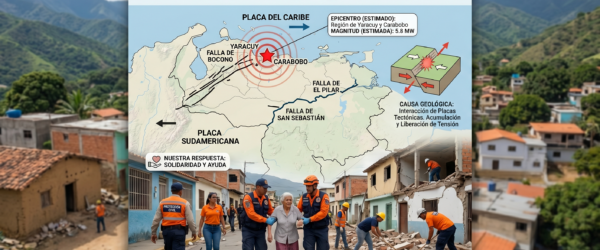
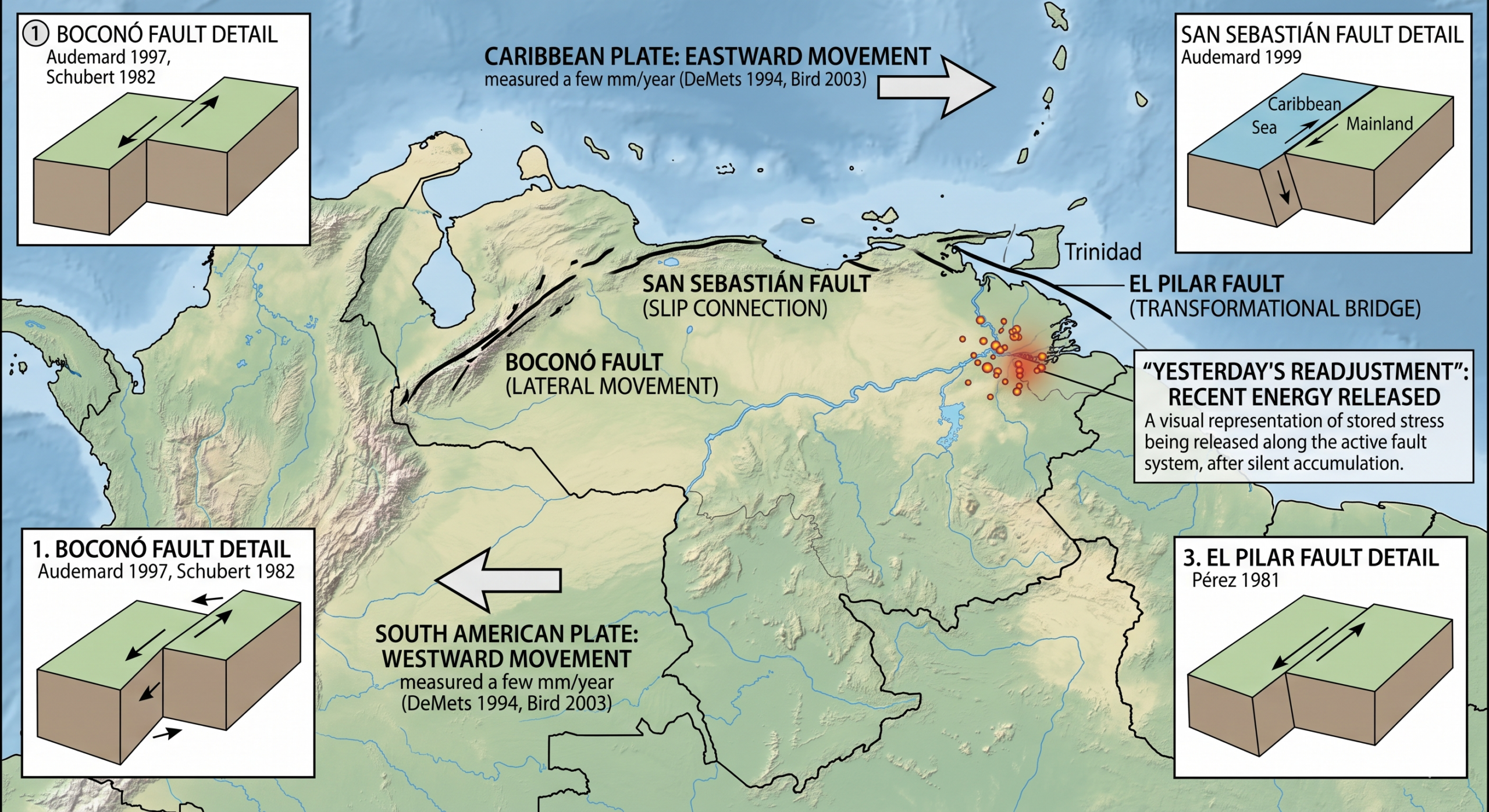
Seismology has described these doublets since the work of Kanamori (1977) and, later, Lay and Wallace (2012), who showed that some faults can release energy in closely related sequences when they share the same state of tectonic stress. A fault is simply a fracture in the Earth’s crust where two blocks of rock have shifted relative to one another, accumulating stress that is occasionally released in the form of earthquakes. What we experienced this week was neither a mystery nor a coded message, but rather the natural expression of a territory located in a complex zone of interaction between tectonic plates—large fragments of the lithosphere that move slowly over the upper mantle, and whose friction accumulates stresses that are occasionally released as earthquakes.
Venezuela is located at the boundary where the Caribbean Plate moves eastward, and the South American Plate moves westward. This movement has been precisely measured since the studies by DeMets in 1994 and Bird in 2003, which confirmed that both plates move about a few millimeters per year. This constant displacement generates friction along active faults that have been studied for decades. The Boconó Fault, described by Audemard in 1997 and by Schubert (1982), runs through the Venezuelan Andes with a lateral movement that slowly accumulates energy. The San Sebastián Fault, documented by Audemard in 1999, runs along the northern coast via a slip that connects the Caribbean with the mainland. The El Pilar Fault, analyzed by Pérez in 1981, acts as a transformational bridge between segments that respond to similar forces. Yesterday, these structures readjusted. Yesterday, they released some of the energy they had silently stored.
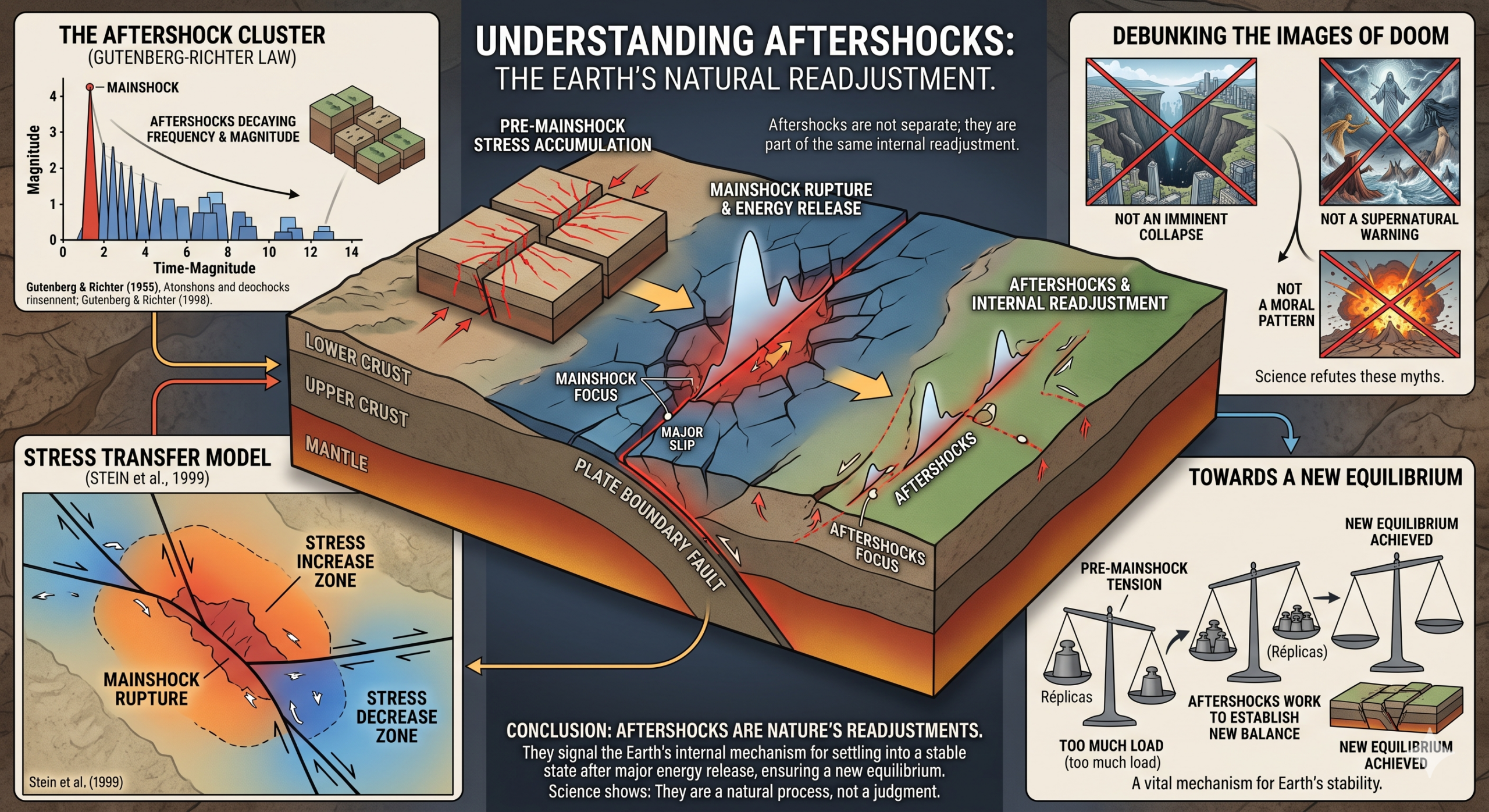
The aftershocks that followed the double earthquake did not herald an end, nor did they signal a tragic fate. Nor did these natural events follow a moral pattern. The aftershocks were part of the same process of internal readjustment. Science has shown—from the studies by Gutenberg and Richter in 1956 to Stein’s models in 1999—that aftershocks are natural readjustments of the Earth’s crust. They are not signs of an imminent collapse or supernatural warnings; rather, they indicate how the Earth achieves a new equilibrium after releasing accumulated energy.
Yesterday, we did not experience a harbinger of the end, but rather the continuation of a process that has lasted millions of years. We experienced a reminder that we inhabit a dynamic planet and the sensation of a land that moves because it is alive. And in that movement, we discovered our own fragility—not as a punishment or a warning, but as part of our belonging to a world that breathes on timescales beyond our imagination.
Understanding this profound rhythm restores our serenity and allows us to distinguish between fear and reality. It invites us to view the tremor not as a judgment but as part of the natural fabric of life. The Earth moved yesterday because it has always done so. And we, by recognizing this, learn to live with humility, with responsibility, and with a fuller awareness of our interdependence with all of creation.
II. Analysis
The human heart seeks meaning when the earth trembles and the stability of daily life is shattered. An earthquake does not merely shake the ground; it also stirs the human inner world, which integrates memory, emotion, thought, and spirituality into a single living organism. Uncertainty opens up spaces that serenity tries to sustain. At that threshold, brief explanations appear, promising to calm fear. Voices emerge offering easy certainties. Theories proliferate, blending anxiety and conspiracy theories to fill the void left by the unexpected.
Psychology recognizes that this search for meaning is part of our human condition. The human organism attempts to make sense of the experience when something bursts in without warning. Anxiety seeks a narrative to bring order to the chaos. Confusion demands someone to blame, and so ideas emerge that attribute the upheaval to hidden forces or divine intentions. But mature faith does not thrive on shortcuts. Theology is not a refuge from panic. Community is not a space for blame disguised as prophecy.
Some religious expressions, though born of a desire to comfort, can increase suffering. Phrases like “God is in control,” “we must leave everything in God’s hands,” or “God alone is enough” seem to offer refuge. Still, they end up simplifying a complex reality and attributing to God decisions that belong to the realm of nature and human responsibility. To claim that God sent the earthquake, that He punished some while protecting others, or that He used the disaster to send warnings turns a human tragedy into an interpretation that neither geology nor Scripture supports. These explanations offer an illusion of certainty, but they end up blaming the victims and obscuring God’s compassionate nature. Instead of bringing relief, they add to the burden of those already carrying too much and distort the image of a God who, according to biblical testimony, remains faithful even when humanity stumbles.
Scripture does not present God as an agent who exploits geological failures to send coded messages. It presents a God who hears the cry; as Psalm 34 affirms, those who turn to the Lord find an answer. It presents a God who sustains, as Psalm 46 proclaims by describing Him as a refuge and strength. It presents a God who does not abandon us, as Hebrews 13 reminds us by affirming that He will neither forsake nor leave those who trust in Him. These images do not justify tragedies or assign blame; rather, they offer support and peace. They do not explain suffering from a distant, transcendent perspective. They embrace it from within the fabric of human history.
The Bible does not say that suffering is a test or that tragedy is a selective punishment. Nor does it say that human vulnerability is a sign of divine disapproval. Magical thinking offers momentary relief because it gives the illusion of control. But it leaves a deeper void when reality reasserts itself. Conspiracy theories offer a narrative that seems to bring order to chaos. But they rob us of serenity and fragment the community. Simplistic theodicy offers answers that sound spiritual. But it betrays the dignity of those who suffer and reduces faith to an explanatory mechanism.
The theological question is not why the earth shook, but where we find God now. And the answer is revealed in what it means to be human. In the solidarity that awakens when hands are extended without asking whom they are helping. In the compassion that organizes itself to support those who have lost more than just possessions. In the hope that it insists on rising even when the ground is shaking. In the community that embraces one another, reminding each other that they are not alone.
Thus, God is not sought in the rupture of the earth’s crust but in the manifestation of tenderness that emerges afterward. We do not find God in the crack in the ground, but rather in the willingness to stand in solidarity with those who suffer. God speaks through the human response that refuses to let disaster have the last word.
III. Action
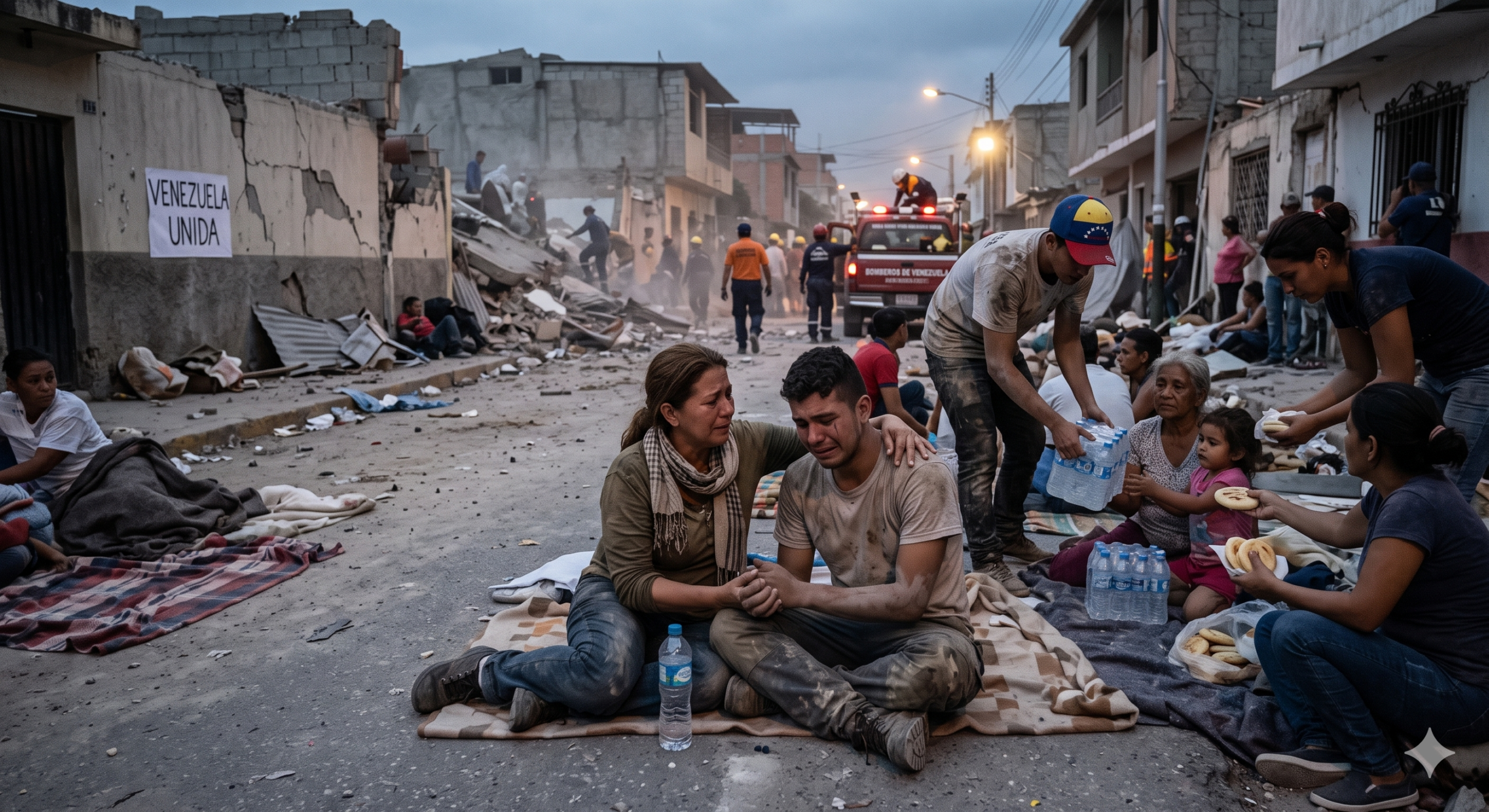
The tremor has passed, but life continues to stir within us with an intensity that invites us to respond with clarity and tenderness. Action becomes a form of healing. It is not an impulsive action meant to mask fear, but rather one born of a deep understanding of what we have experienced and a commitment to those who share the fragility of the moment. The earth shook, and now it is up to us to move toward care, solidarity, and the reconstruction of what the event disrupted.
Serenity begins when we understand that aftershocks are part of the territory’s natural readjustment. They do not herald a greater disaster. They are not hidden signs. They are the echo of a process seeking balance. This understanding does not eliminate anxiety, but it transforms it into an active calm that allows us to think clearly and act prudently. Science offers us this framework to breathe with greater confidence and distinguish between paralyzing fear and protective vigilance. The sage in Proverbs reminds us that knowledge gives life to those who possess it (Proverbs 16:22). Serenity is not passivity but clarity for action.
Action is also manifested in presence. A presence that does not need to explain everything, nor demand that the other person be okay. A presence that offers support without imposing interpretations. When someone has experienced a profound shock, what sustains them most is knowing they are not alone. The community becomes a space where shared vulnerability is transformed into strength. There, people share water, food, accurate information, and the silence that is sometimes more healing than any words. The apostle Paul reminds us to bear one another’s burdens (Galatians 6:2). That is the most concrete way to embody compassion.
Emotional care becomes an essential part of the response. There is no separation between what we feel, what we think, and what we do. Everything is intertwined in the human experience. That is why it is necessary to listen to exhaustion, acknowledge accumulated tension, allow the organism to find its rhythm, and let the inner self find words for what has been experienced. Compassion begins with oneself and extends to others as a natural gesture of humanity. Hope is strengthened when fear is acknowledged without shame, and the community is allowed to bear what one cannot bear alone. The psalmist affirms that the Lord is close to the brokenhearted (Psalm 34:18). That closeness becomes visible when we support one another.
Action also involves rebuilding—not only physical structures, but also bonds, trust, and meaning. Every gesture of help is a way of affirming that life goes on. Every act of solidarity is a way of saying that the earthquake does not have the final say. Every effort to organize, collaborate, and share resources is a declaration of dignity in the face of fragility. Rebuilding is not just a technical process. It is a spiritual process that reminds us that we are capable of rising together. The prophet Isaiah proclaims that rubble can become new foundations (Isaiah 58:12). That promise is fulfilled when the community takes action.
Prayer becomes a space for deep breathing. It is not a prayer that seeks explanations. It is not a prayer that tries to convince God to change what has already happened. It is not a prayer that makes God the author of the disaster. Prayer is a dialogue for action. Prayer changes human beings, not God. Prayer awakens compassion, sharpens conscience, strengthens the will, and guides human beings toward the good. Prayer is an act of solidarity because it predisposes us to act with love. Prayer reminds us that faith is not escapism, but commitment. Jesus taught that whoever hears his words and puts them into practice is like one who builds on rock (Matthew 7:24). Prayer prepares us for that practice.
Worship also takes on a deeper meaning. Worship is not merely singing or uttering words. Worship consists of acting in a way consistent with God’s merciful character. Worship is making God present in the world through compassion. Worship is embodying the mercy that sustains those who tremble. Worship is reaching out, offering comfort, sharing what we have, rebuilding what was lost. Worship becomes a movement toward the other. A movement that reveals that God is not far away. God is in the caring action. God is in the tenderness that sustains. God is in the justice that is organized. God is in the hope that persists.
The final act is the simplest and the most profound, which is to remember that we are not alone. To remember that community is a refuge. Remembering that shared vulnerability becomes strength, that life continues with dignity, and that no earthquake can take it away. The earth shook, but we are still here. We are still standing. We continue to care for one another. We continue to learn to live with humility in a world that breathes and transforms.
The hope that emerges after an earthquake is neither naive nor passive. It is not an invitation to disregard reality or to delegate to faith what falls under human responsibility. Mature hope recognizes that life is a gift that must be cared for with wisdom and love. That is why the best ethical response also includes concrete decisions that protect people and strengthen communities. Prevention becomes a form of solidarity. Preparedness becomes an act of mutual care. Shared responsibility becomes an expression of love for one’s neighbor.
Building safe homes affirms that human life deserves protection. Strengthening earthquake-resistant engineering is a gesture of respect toward those who live in this region. Educating the public is a way of empowering each person to act calmly in the face of uncertainty. Conducting drills is an exercise in collective memory that reminds us that preparedness saves lives. Having family emergency plans is a way to care for those we love most. All of this is part of the same spirit that invites us to support and sustain one another, and to rebuild together.
Prevention does not contradict faith; rather, it embodies it and makes it tangible. It transforms it into a protective ethic. Hope does not eliminate responsibility but rather inspires, guides, and strengthens it. The hope that remains after the earthquake is also expressed in these actions that seek to reduce damage, preserve lives, and build safer communities. Hope thus becomes a force that drives us to act with wisdom, compassion, and deep care.
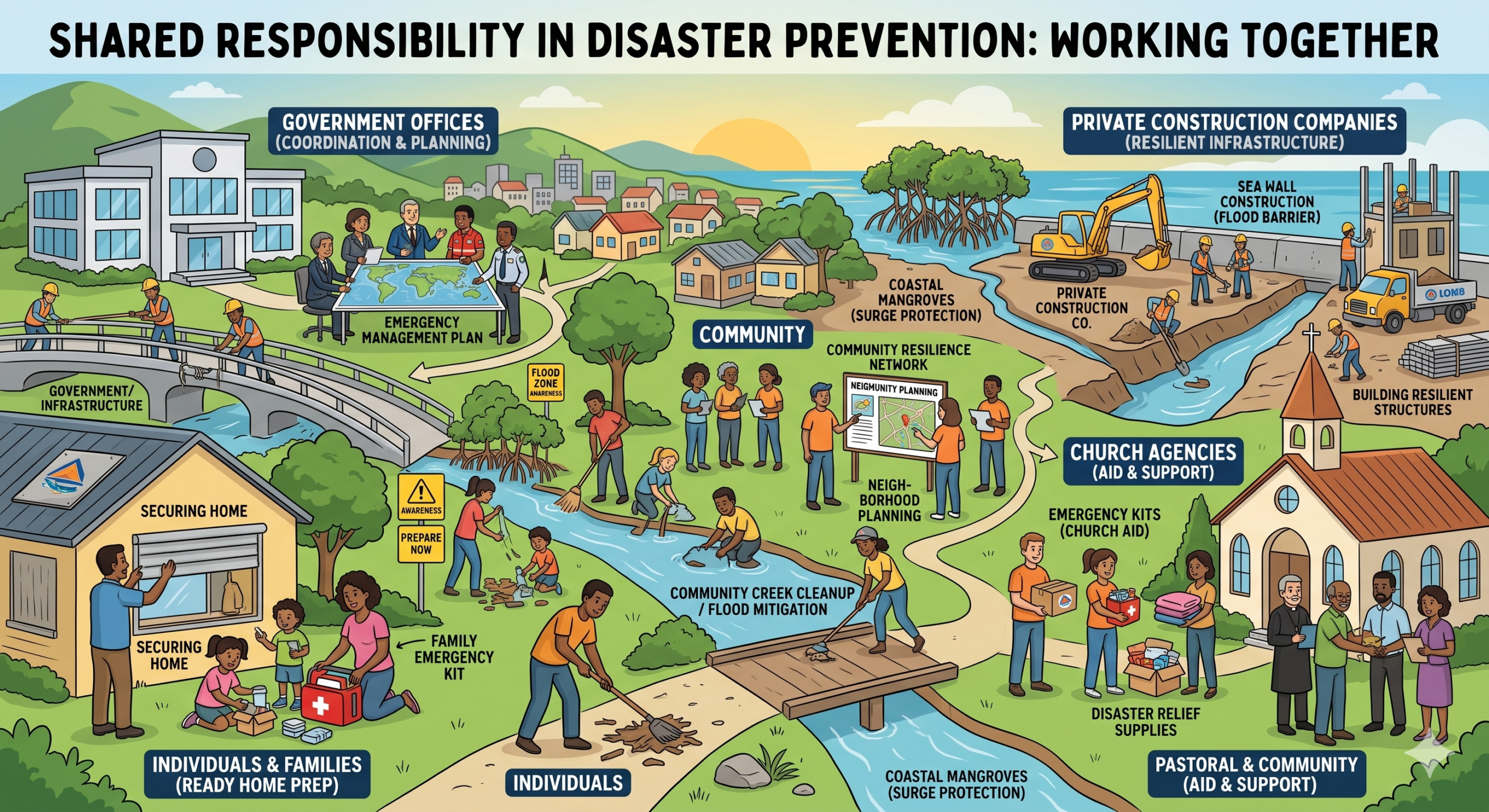
A commitment to prevention is never the task of individuals alone. It is a shared responsibility that involves persons who take care of their own households, families who prepare together, communities that cultivate a culture of readiness, church agencies that offer guidance and support, government offices that ensure public safety, and private construction companies that honor ethical standards in every structure they build. When each sector embraces its part, prevention becomes a collective covenant that protects life and strengthens the bonds that hold society together.
Conclusion
The solidarity that is expressed and the hope that emerges when the ground shakes reveal something essential about the human condition. The earth shook, and the country felt the weight of its own fragility. However, the story does not end with the earthquake. The story begins with the response. Mature faith does not seek to assign blame, nor does it interpret tragedy as a coded message. Mature faith becomes presence, compassion, and concrete action that sustains those who feel the world has become uncertain. Science helps us understand what happened. Psychology helps us tend to what stirs within us. Theology helps us remember that God is not revealed in the rupture of the earth’s crust, but in the tenderness that emerges afterward.
Prayer thus becomes an act of transformation, awakening compassion, sharpening our awareness, and strengthening our will. Furthermore, it prepares us to act with love. Prayer is an act of solidarity because it predisposes us to be a presence for others. Worship takes on a deeper meaning when understood as a movement toward our neighbor. To worship is to act as God acts. To worship is to make God present in the world through compassion. To worship is to embody the mercy that sustains those who tremble. To worship is to reach out, offer comfort, share what we have, and rebuild what was lost.
The earth shook, but our dignity remained unbroken. Our ability to care for one another remained unbroken. God’s presence among us remained unbroken. We are still here. We remain standing. We continue to learn to live with humility in a world that breathes and transforms. And in that learning, we discover that hope is not a fleeting feeling. It is a way of life that is renewed every time we choose compassion over fear, solidarity over isolation, and responsible action over resignation.
References
Audemard, F. A. (1999). Quaternary fault kinematics and stress regime of Venezuela. Journal of Geodynamics, 27(1), 17–33.
Audemard Mennessier, F. A. (1997). Holocene and historical earthquakes on the Boconó fault system, southern Venezuelan Andes: Trench confirmation. Journal of Geodynamics, 24(1–4), 155–167.
Bird, P. (2003). An updated digital model of plate boundaries. Geochemistry, Geophysics, Geosystems, 4(3), 1027.
DeMets, C., Gordon, R. G., Argus, D. F., & Stein, S. (1994). Effect of recent revisions to the geomagnetic reversal time scale on estimates of current plate motions. Geophysical Research Letters, 21(20), 2191–2194.
Gutenberg, B., & Richter, C. F. (1956). Earthquake magnitude, intensity, energy, and acceleration. Bulletin of the Seismological Society of America, 46(2), 105–145.
Kanamori, H. (1977). The energy release in great earthquakes. Journal of Geophysical Research, 82(20), 2981–2987.
Lay, T., & Wallace, T. C. (2012). Modern global seismology. Academic Press.
Pérez, O. J., & Aggarwal, Y. P. (1981). Seismotectonics of northeastern Venezuela and the southern Caribbean region. Tectonophysics, 79(1–3), 1–25.
Schubert, C. (1982). Neotectonics of the Boconó Fault, western Venezuela. Tectonophysics, 85(1–2), 205–220.
Stein, S. (1999). The role of stress transfer in earthquake occurrence. Nature, 402(6762), 605–609.